· OtherFree
Haines Gallery: 250 Years, Indigenous Futures
- When
- Thursday, September 17 · 10:30 AM – 8:00 PM
- Where
- San Francisco
- Listed by
- Fort Mason Center
250 YEARS, INDIGENOUS FUTURES PRESENTED BY HAINES GALLERY
As the U.S. marks its 250th anniversary, Haines Gallery presents 250 Years, Indigenous Futures, a group exhibition centering the work of leading Native American artists. While occasioned by this anniversary, 250 Years, Indigenous Futures does not commemorate it.
ABOVE: Haines Gallery is in Building C (far right). TOP OF PAGE: Wendy Red Star: “Chiaxxúapilake (Fifty),” 2025 (detail) Fabric with archival pigment photograph on board 25.25 x 49.25 x 1.25 inches, framed
EVENT DETAILS
250 Years, Indigenous Futures takes its title from the writings of Standing Rock Sioux historian Philip J. Deloria and his colleagues, who argue that Native peoples should be understood not primarily through the past, but “through the lens of futurity.” Indigenous knowledge, they write, is not peripheral to contemporary life but generative of new ways of understanding it. In this spirit, the exhibition considers Native presence and creativity as powerful forces shaping our collective future.
The artists in the exhibition are: Victoria Grace Canby (Diné [Navaho]);Jordan Ann Craig (Northern Cheyenne); Sky Hopinka (Ho-Chunk Nation / Pechanga Band of Luiseño Indians); Brad Kahlhamer (Indigenous ancestry); Terran Last Gun (Piikani / Blackfoot); Jamie Okuma (Luiseño, Shoshone-Bannock, Wailaki, Okinawan, and La Jolla); Wendy Red Star (Apsáalooke [Crow]); and Keith Secola (Northern Ute / Anishinaabe). Working across painting, drawing, sculpture, film, and photography, these artists engage contemporary culture, Nation-specific visual traditions, and personal histories in distinct and expansive ways.
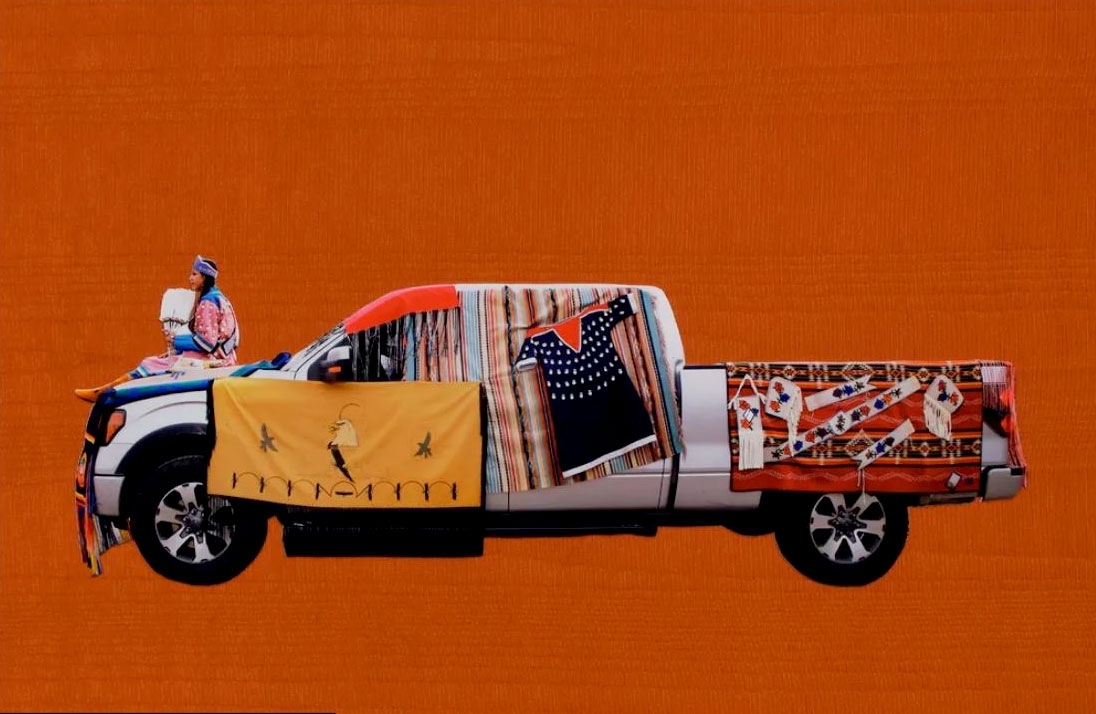
Rather than commemorating the 250th U.S. anniversary, the exhibition recognizes 1776 as only one moment within much longer histories of Indigenous presence, adaptation, and sovereignty. Creating space for artists to define their own terms of engagement, the exhibition aims to bring forward concerns central to their practices. The works on view draw inspiration from a vivid range of sources: boldly painted Piikani lodges; the precise geometry of Northern Cheyenne beadwork; the Indians of All Tribes’ occupation of Alcatraz; cars adorned with blankets and regalia for the annual Crow Fair; blood-soaked horror films; and archival photographs whose subjects meet the visitor’s gaze.
The exhibition is informed by Apsáalooke artist Wendy Red Star’s caution against a “foe-based” framing of Native art – one that risks tethering meaning to resistance alone and obscuring the specificity of Nations, histories, and individual practices. Here, each artist’s work emerges from particular relationships to language, land, and material culture. No single framework can contain these worlds.
ABOUT THE ARTISTS
Victoria Grace Canby (Diné, b. 1978, Albuquerque, NM). Marin-based artist Victoria Grace Canby’s new works on paper, created for the exhibition, depict the Three Sisters – corn, beans, and squash – as a living model of resilience, healing, and collective care that connects Indigenous Peoples throughout the Americas. “Through fostering our connection to these plants’ powers,” Canby notes, “we can overcome the impacts of colonization.”
Jordan Ann Craig (Northern Cheyenne, b. 1992, San Jose, CA). Jordan Ann Craig’s paintings draw from references ranging from Northern Cheyenne beadwork and quillwork to the postwar abstraction of Agnes Martin, all of which she translates into exacting, poetic fields of color and form. In works such as “Miss Your Musk” (2024), Craig foregrounds Indigenous abstraction as a living and evolving practice – one capable of holding personal narrative, formal experimentation, and cultural continuity without being reduced to any single source or meaning.
Sky Hopinka (Ho-Chunk Nation/Pechanga Band of Luiseño Indians; b. 1984, Ferndale, WA). Sky Hopinka’s film Sunflower Siege Engine (2022) brings together distinct Indigenous sites and histories, connecting the Indians of All Tribes’ occupation of ne…