⌘ Tech
Reliable agents: memory, execution state and recovery
- When
- Wednesday, October 14 · 6:00 PM – 5:00 AM
- Where
- San Francisco
- Listed by
- Lu.ma — neo4j
Description
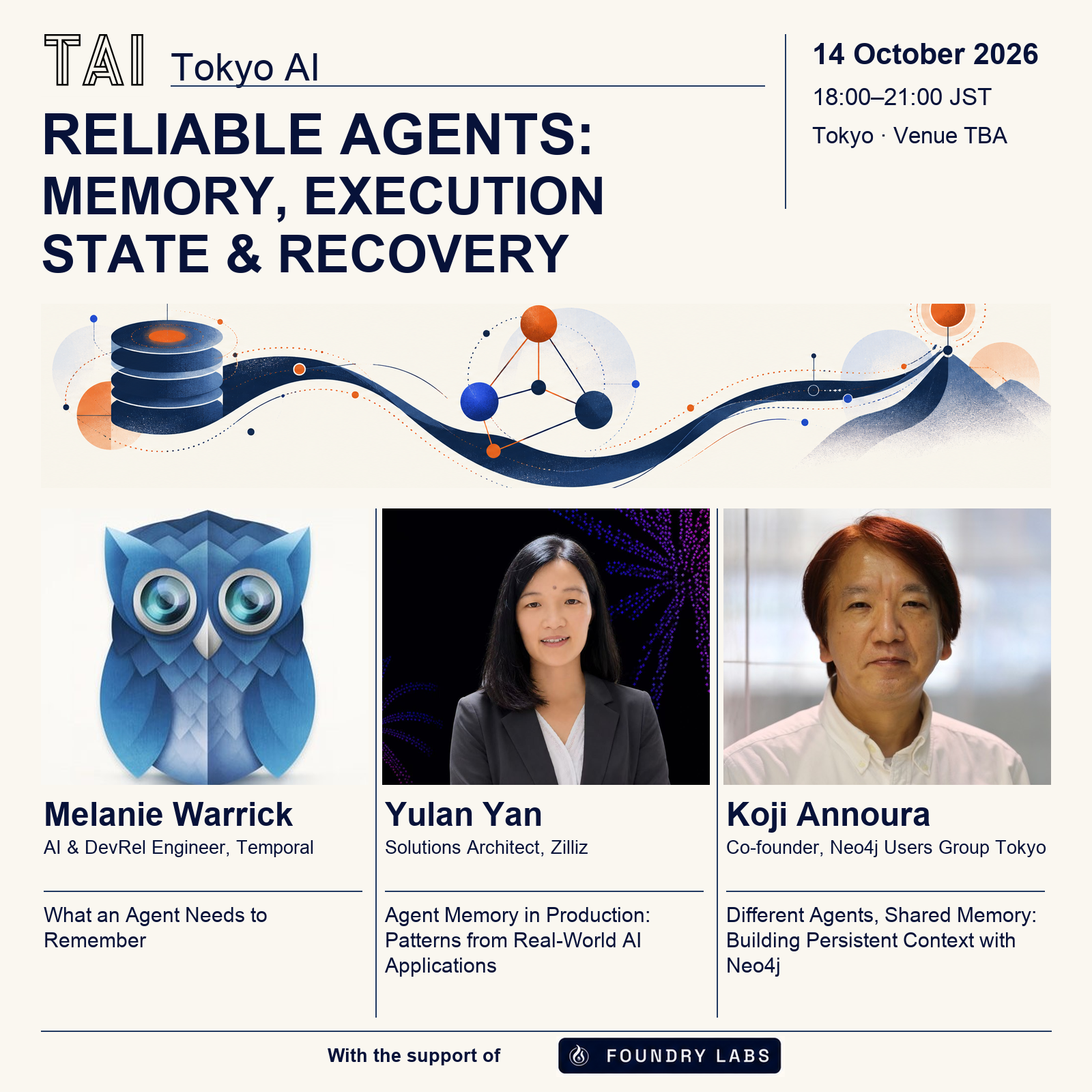
An agent can remember the facts of a task and still lose track of its work. Join Tokyo AI (TAI) for an evening on agent memory, execution state and recovery: what to retain for reasoning, what to record reliably, and how to continue after interruption.
Designed for engineers building and operating agents, application architects and technical leads, this event connects memory and retrieval choices with the reliability requirements of long-running systems.
Melanie Warrick, working on AI developer relations engineering at Temporal, will present What an Agent Needs to Remember, including a live demo. Koji Annoura will present Different Agents, Shared Memory: Building Persistent Context with Neo4j, demonstrating shared context across agents with Neo4j and MCP. Yulan Yan of Zilliz will present Agent Memory in Production: Patterns from Real-World AI Applications, examining patterns from production AI applications.
When: Wednesday, October 14, 2026. The 18:00-21:00 JST window shown here is provisional and will be confirmed with the venue.Where: Tokyo, venue to be announced.
Agenda
Provisional schedule, subject to venue and lineup confirmation. Each talk slot includes Q&A.
18:00 - Doors open18:25-18:30 - Welcome18:30-19:00 - What an Agent Needs to Remember (Melanie Warrick)19:00-19:30 - Agent Memory in Production: Patterns from Real-World AI Applications (Yulan Yan)19:30-20:00 - Different Agents, Shared Memory: Building Persistent Context with Neo4j (Koji Annoura)20:00-21:00 - Networking21:00 - Doors close
Talks
What an Agent Needs to Remember
Speaker: Melanie Warrick (DevRel, Temporal)
Abstract:
Ask what an agent should remember and you’ll usually hear about working, episodic, semantic, and procedural memory. These describe information available to the agent as it reasons. But an agent can remember every fact about a task and still forget where it is in the task.
Production agents also need reliable execution state: which tools ran, which side effects occurred, what a person told the agent, what work completed, and what should happen next. This talk distinguishes what an agent knows from the state of its work and explains why they have different correctness requirements. A live demo makes the distinction visible: an agent that remembers everything about its task but still cannot tell whether it already performed an action.
Then we’ll take the problem into long-running agents, where preserving execution history creates another challenge: the history itself can become too large. Temporal provides the durable execution examples, but the architectural question applies more broadly: what must a system preserve so an agent can resume its work, not just recall what the work was about?
Bio:
Melanie Warrick works on AI developer relations engineering at Temporal, focused on building reliable AI systems and agents. She is also co-founder and CTO of Fight Health Insurance, an AI platform that helps people appeal denied US health insurance claims.
Melanie has worked in AI for more than a decade, from implementing an open source neural networks platform (Skymind) and fine-tuning domain models (FHI) to deploying AI applications in production. Her broader engineering background spans distributed systems, developer infrastructure, and health tech, including work at Google Cloud and engineering leadership at startups.
Agent Memory in Production: Patterns from Real-World AI Applications
Speaker: Yulan Yan (Founding Solutions Architect, Zilliz)
Abstract:
Agent memory can mean very different things depending on the product: retaining past conversations, consolidating interactions into higher-level profiles, reusing prior task experience, or keeping years of personal history available for future interactions.
This talk shares several real-world production systems across AI companions, enterprise agents, robotics, and personal AI devices, where Milvus and Zilliz Cloud serve as the vector database layer for memory storage a…