⌘ Tech
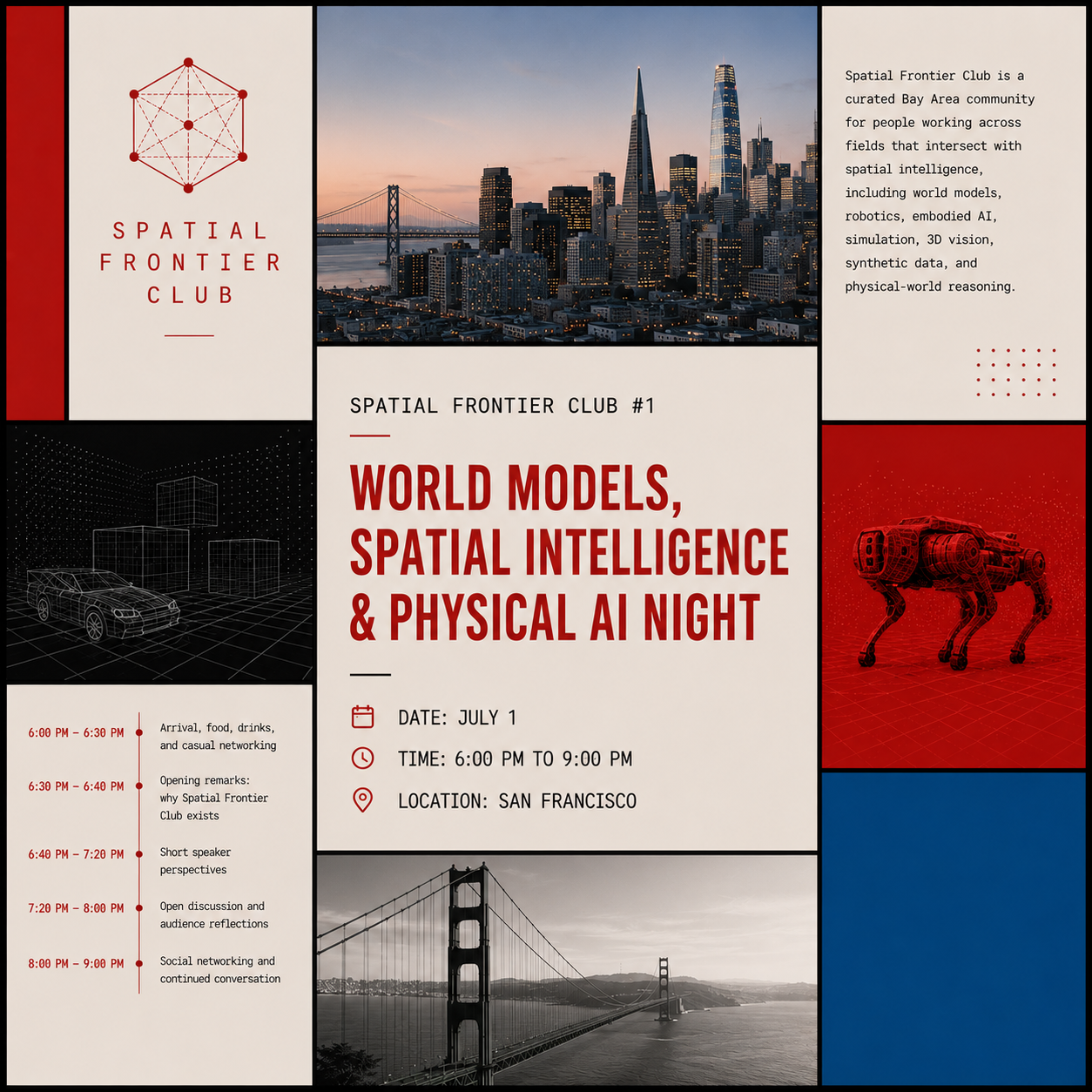
World Models, Spatial Intelligence & Physical AI Night
- When
- Wednesday, July 1 · 6:00 PM – 9:00 PM
- Where
- San Francisco
- Listed by
- Lu.ma — Gen AI SF
About the Event
Spatial Frontier Club is a curated Bay Area community for people working across fields that intersect with spatial intelligence, including world models, robotics, embodied AI, simulation, 3D vision, synthetic data, and physical-world reasoning.
As AI moves beyond language and screens, one of the next major frontiers is the ability for machines to understand, model, predict, and interact with the physical world. This shift is bringing together researchers, engineers, founders, and investors working on the systems, data, models, and infrastructure needed for the next generation of Physical AI.
For our first gathering, we’re bringing together a focused group of people actively building, researching, or investing in this frontier.
The format will be lightweight and conversational. We’ll begin with a few short speaker perspectives to set the tone, followed by open discussion and time to connect with relevant peers. The goal is not to create another broad AI meetup, but to build a more focused room for people thinking deeply about spatial intelligence and AI’s physical-world frontier.
Who Should Attend
This gathering is intended for people working in or closely around:
Spatial intelligenceWorld modelsRobotics and embodied AISimulation and synthetic environments3D vision, 3D graphics, and 3D dataRobot learning and foundation modelsVLA / VLN systemsPhysical AI infrastructureSpatial computing and physical-world reasoning
We welcome researchers, engineers, technical founders, builders, investors, and ecosystem partners whose work directly touches these areas.
To keep the room focused and high-signal, capacity will be limited and registration may be reviewed.
Event Format
6:00 PM to 6:30 PMArrival, food, drinks, and casual networking
6:30 PM to 6:40 PMOpening remarks: why Spatial Frontier Club exists
6:40 PM to 7:20 PMShort speaker perspectives
7:20 PM to 8:00 PMOpen discussion and audience reflections
8:00 PM to 9:00 PMSocial networking and continued conversation
Discussion Themes
We’d love to hear your thoughts on questions such as:
What is still the biggest bottleneck for Physical AI?Are world models limited more by data, architecture, or evaluation?How important are synthetic environments for future embodied systems?What is still missing between prediction and action?What does the next generation of Physical AI infrastructure look like?Where is spatial intelligence most likely to matter in the next wave of AI systems?
Featured Speakers
Jiachen (Amber) Liu
Founder of a stealth AI startup backed by DCVC. Previously a Research Scientist at Meta Superintelligence Lab, where she worked on large-scale foundation model training systems, and a researcher at the University of Michigan focused on machine learning systems. Her work sits at the infrastructure layer behind frontier AI, spanning scalable training, model/data pipelines, and systems design. Amber will share perspectives on the infrastructure needed to support Physical AI, including world models, simulation-driven data, and embodied intelligence.
2. Daniel Ho
Director of Evaluation at Project Prometheus, where he focuses on evaluating embodied AI capabilities. His work sits at the intersection of robot learning, real-world performance evaluation, and the broader infrastructure needed to measure progress in Physical AI. Daniel will share perspectives on learning methods in robotics, with a focus on locomotion, manipulation, and how better evaluation frameworks can help bridge the gap between simulation, policy learning, and deployment in the physical world.
3. Anthony Zhao
Head of North America at SpatialVerse / Manycore Tech, where he works across AI, robotics, simulation, and 3D technology teams to understand how spatial data infrastructure can support Physical AI. His work sits at the intersection of technical strategy, frontier AI partnerships, synthetic data, and 3D simulation, giving him a market-facing view into where current systems sti…